
Baltersan and the Baronial Dignity of Crossraguel
A historical interpretation of the evidence connecting the ownership of Baltersan with the older dignity of Baron of Crossraguel.

I believe the current owner of Baltersan has the strongest historical claim to be regarded as the Baron of Crossraguel. My argument rests on two propositions: the annexation of the abbacy to the bishopric of Dunblane does not by itself determine ownership of the separate baronial dignity, and the residence James VI called the “hous and place of Corsragwell” should, in my interpretation, be identified with Baltersan.
This is a historical argument I advance in my own name, and I accept responsibility for its interpretations. An unanswered question must not quietly become a negative conclusion. A missing document may prevent certainty without establishing that a proposed connection never existed. That distinction must apply consistently to every competing account of Crossraguel’s secular succession and the identity of its royal residence.

The benefice and the regality
Crossraguel’s baronial history began before the surviving Baltersan tower. Robert I erected the abbey lands into a free barony in 1324. Robert III’s charter of 1404 granted free regality, including extensive judicial privileges. The Crown had created a territorial jurisdiction associated with the abbey’s lands. Its history therefore cannot be reduced to the history of the monastic buildings.
The abbacy brought together different interests. Its benefice provided property and income for an ecclesiastical institution. Its regality supplied powers of secular government derived from the Crown. These were related but not identical. When the abbacy was later annexed to the bishopric of Dunblane in 1617, the parliamentary act concerned the spiritual and temporal rights of the benefice and the monastic buildings. It did not expressly extinguish or transfer the separate baronial dignity of the regality.
The “hous and place of Corsragwell”
On 21 February 1602 James VI wrote to Sir John Vaus of Barnbarroch:
“In respect we intend to caus build and repair the hous and place of Corsragwell to the use of our dearest sone the Prince to quhome the same is maist proper for his residence quhen he salhappin to resorte in thai pairtes. We have heirwith send to you a dimissioun of the sam place and monasterie in favour of our said dearest sone…”
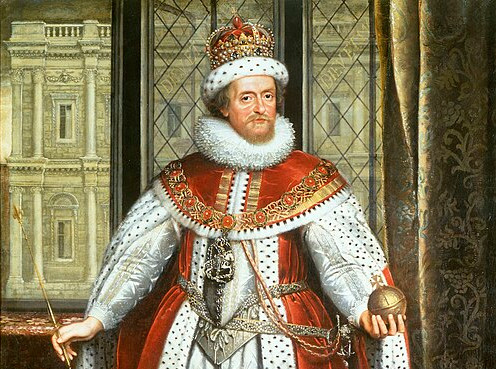
James VI and I, early 17th-century portrait. Public domain.
The letter draws a clear distinction. It identifies the “hous and place of Corsragwell” as the residence that was to be built and repaired specifically for Prince Henry’s use. Separately, it requests a demission of “the sam place and monasterie,” while protecting Vaus’s rights to the rents and duties of the benefice.
This distinction is significant. The king was not simply asking to take over the monastic buildings for the Prince. He was proposing to create or improve a “hous and place” suitable as a residence for the heir apparent. The wording treats the residential building and the monastery as related but not identical.
In my interpretation, this points away from the abbot’s tower inside the abbey precinct and toward a secular residence associated with the estate. Baltersan already had a documented mansion and orchards by 1574. Construction of the present fortified tower house was begun on 1 March 1584 by John Kennedy of Pennyglen (a half-brother of the fourth Earl of Cassillis) and his wife Margaret Cathcart. Building a substantial L-plan tower of this quality took several years. By 1602 the work would still have been relatively recent, and the building was in the process of being established as a modern fortified residence rather than an old completed castle with a long-settled alternative name.
The letter does not name “the castle of Baltersan” or “the house of Baltersan” because the site was still being transformed from an existing mansion into a fortified tower suitable for a prince. A king, or the heir apparent, would be expected to lodge in a fortified manor, not in the private rooms of an abbot within a monastery.
Baltersan stands close to the abbey, within the former regality lands, and had an established residential history stretching back at least to 1530. On the evidence of the letter’s own wording, combined with that residential and family history, it remains the strongest candidate for the “hous and place” the king intended to prepare for Prince Henry. The separation the letter makes between the residence to be built and repaired and the monastery itself is the foundation of that identification.
Further evidence of the continued use of Baltersan as the principal residence appears three years after the tower was begun. A contract dated at Baltersan on 6 March 1587 (National Records of Scotland, GD25/1/950) records that John Kennedy of Pennyglen and Margaret Cathcart, his wife, disponed the plenishing of John’s house in the burgh of Maybole to John Davidson of Greenan and his wife, in return for a liferent infeftment in lands at Greenan. The document distinguishes the house in Maybole from Baltersan itself, where the contract was executed. While the deed does not expressly record a removal, the fact that John and Margaret were acting at Baltersan and were prepared to part with the contents of the Maybole house is consistent with Baltersan having become their principal residence by that date — three years after the tower was begun, and at a time when the new building would have been sufficiently advanced for them to leave their former town house.
Later succession and the dignity
The later history of the lands does not extinguish the dignity. The succession after the early seventeenth century continues to show Kennedy and then Arbuthnot interests in lands expressly described as lying within the regality of Crossraguel.
John Kennedy of Baltersan died in 1721. The house then passed to Hugh Arbuthnot, a sea captain based at Deptford. Hugh was admitted as a burgess and guild brother of Ayr on 1 May 1725. These details place the inheritance in a recognisable family and local setting; the title papers then show which lands were involved in particular steps of the succession.
A case paper dated 29 August 1723 concerns Sir John Kennedy of Culzean’s claim against Hugh Arbuthnot to certain lands, referring to a 1701 disposition by Hew Kennedy of Ardmillan and Baltersan. The catalogue identifies a title dispute; it does not disclose a final judgment about the regality’s dignity. A separate precept of clare constat of 9 July 1725 was issued by John, Earl of Cassillis, in favour of Hugh Arbuthnot as heir to John Kennedy of Baltersan. It concerns the £8 lands of Easter Dunvin, also called Bogside and Boghead, Wester Dunvin and Trees, expressly described as being within the regality of Crossregal.
This places a Kennedy predecessor and an Arbuthnot successor within a formal land succession still using the regality’s territorial designation more than a century after the Dunblane annexation. A precept of clare constat was part of completing an heir’s land title through the superior. In this record, Cassillis issued the instrument, Arbuthnot was the heir being recognised, and John Kennedy of Baltersan was the deceased predecessor. Reading those roles separately avoids turning a succession to particular regality lands into an unexplained transfer of every right connected with Crossraguel.
I regard that continuity as evidence against treating 1617 as the end of the secular story. It supports investigation of the Kennedy estate and its successors. Describing a Kennedy as the last representative of the regality would go further: that status has not been established by the catalogue descriptions, which concern title to specified lands.
Baltersan was roofless by the time of Robert Adam’s view in 1762. The building’s decline explains its later survival as a ruin. It does not determine the succession of the estate interests: a house can cease to be occupied while ownership and the rights associated with the lands continue through deeds and inheritance.
Under the Abolition of Feudal Tenure etc. (Scotland) Act 2000, section 63 preserved certain feudal dignities. The question is not whether a modern title of ownership exists, but whether the historical evidence points to Baltersan as the place most closely associated with the secular residence and jurisdiction that the Crown itself recognised in 1602.
I advance this as an interpretation grounded in the wording of the royal letter, the documented residential history of Baltersan, and the distinction between the benefice and the regality. It does not depend on the 1617 annexation having transferred the baronial dignity, nor on any claim that the letter names Baltersan expressly. It rests on the separation the letter itself draws between the “hous and place” prepared for the Prince and the monastery, and on the identification of that place with the fortified residence the Kennedys were establishing at Baltersan.
References
[1] Charters of the Abbey of Crosraguel (1886), document 131 (James VI to Sir John Vaus, 21 February 1602).
[2] Charters of the Abbey of Crosraguel (1886), document 133 (Act of Annexation, 1617).
[3] National Records of Scotland, GD25/1/950 (contract dated at Baltersan, 6 March 1587).
[4] James Brown, “Baltersan: a stately tower house in Ayrshire”, Proceedings of the Society of Antiquaries of Scotland, vol. 130 (2000), pp. 725–742.
[5] Abolition of Feudal Tenure etc. (Scotland) Act 2000, section 63.
[6] National Records of Scotland, GD25/8/1004 (case for Sir John Kennedy of Culzean against Hugh Arbuthnot, 29 August 1723).
[7] National Records of Scotland, GD27/1/401 (precept of clare constat, 9 July 1725).
This article presents a historical interpretation advanced by Angelo Ovidi. It should be read as a published position rather than as an independent legal determination.